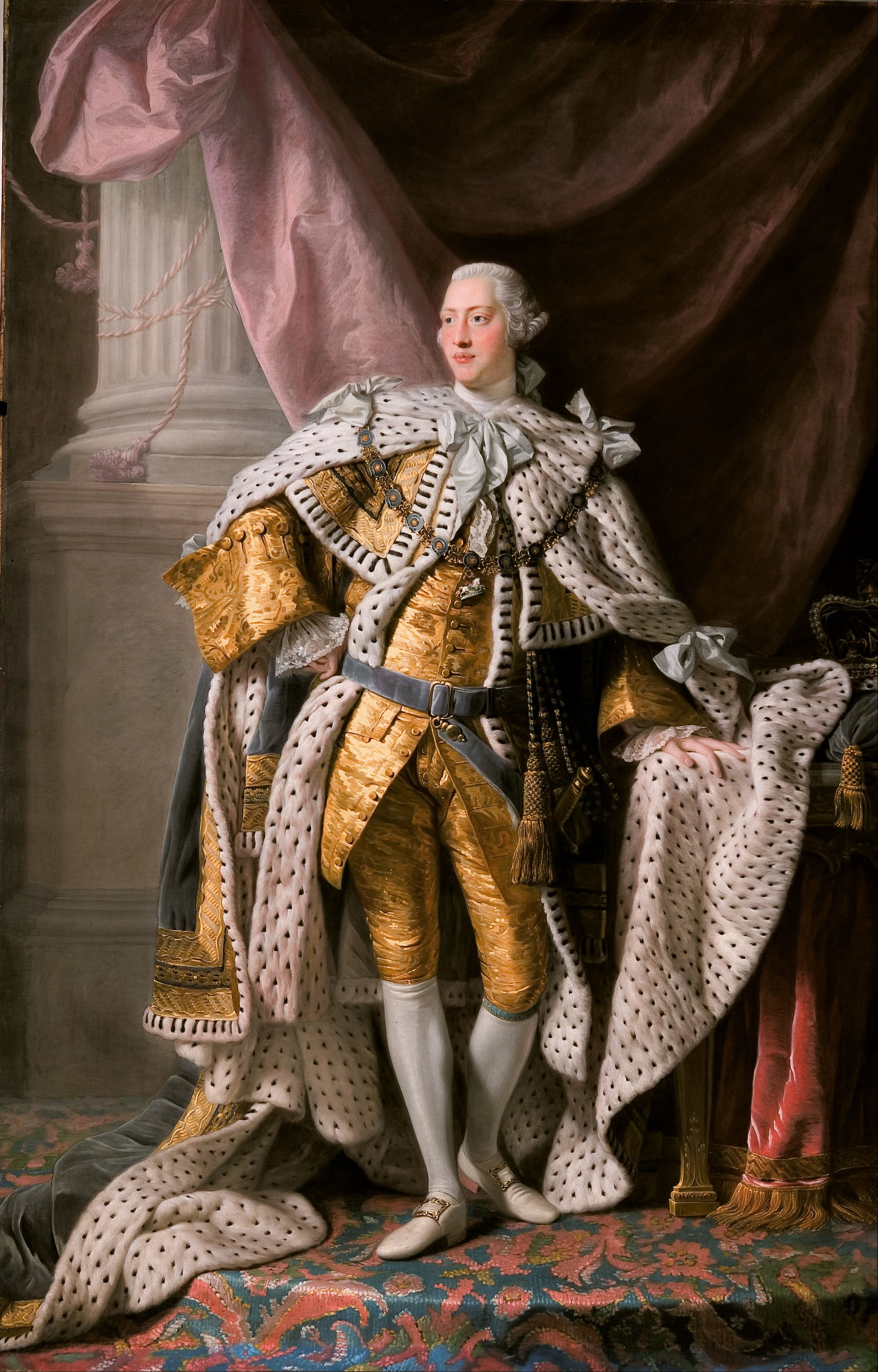
This Saturday, the Royal Collections Trust opened an on-line portal into its largely unseen collection of private documents relating to the reign of King George III, as part of a project described by the Guardian newspaper as 'a radical reappraisal of George III, one that pitches him as a complex, humane and deeply engaged polymath.' The documents themselves are part of the Georgian Papers programme: a massive on-line project, originally launched in the opening months of 2015, and intended 'to transform access to the extensive collection of Georgian papers, held in the Royal Archives and Royal Library at Windsor Castle.'
Amongst the vast collection of materials currently available for public view by anyone, anywhere in the World, with access to a computer and the internet, are a series of essays by King George III himself on a vast range of subjects. From History, to Revenue and Taxation, from the English Constitution to Theology and Moral Philosophy. And, according to the compilers of this all new on-line catalogue, much of this material is 'believed to have been created by George III during his schooling and later as King reflecting on various subjects. They comprise both original work - typically in the form of essays - and notes on the work of other writers which may have been used - or intended for use - in the writing of the essays.'
Thus, the image that is created is a very far cry indeed from the way many former history students remember the King himself, as the lunatic tyrant who lost America. The world famous English actor, Malcolm Macdowell, whilst playing the role of Mick Travis in the Lindsay Anderson cult classic 'sixties movie 'If.....' refers to King George III as 'the mollusc who never found his rock'; in direct reference to the great historical writer J. H. Plumb. Elsewhere, in a letter from Thomas Jefferson to John Adams, dating from 28th September 1789 and written to Adams in his then role as Ambassador to Great Britain, he is referred to as a 'stupid king' seemingly intent on forcing the newly independent America out of its position of neutrality by dragging it into England's disputes with Revolutionary France. Disputes that would ultimately lead to the declaration of war on 1st February 1793 that was to usher in the Napoleonic Era.
But, perhaps the most scathing attack on King George that has survived can be found in the so called "anti-slavery clause", drafted, once again, by Thomas Jefferson, for insertion into the Declaration of Independence, prior to its subsequent removal; at the behest of representatives of South Carolina. In it, Jefferson refers to how the King 'has waged cruel war against human nature itself, violating it's most sacred rights of life & liberty in the persons of a distant people who never offended him, captivating & carrying them into slavery in another hemisphere, or to incur miserable death in their transportation thither. this piratical warfare, the opprobrium of infidel powers; is the warfare of the Christian king of Great Britain. determined to keep open a market where MEN should be bought & sold he has prostituted his negative for suppressing every legislative attempt to prohibit or to restrain this execrable commerce: and that this assemblage of horrors might want no fact of distinguished die, he is now exciting those very people to rise in arms among us, and to purchase that liberty of which he has deprived them, by murdering the people upon whom he also obtruded them: thus paying off former crimes committed against the liberties of one people, with crimes which he urges them to commit against the lives of another.'
On the face of this then, it is perhaps ironic that the person who has to all intents and purposes been most singularly responsible, more than any other, for establishing King George III's reputation as a tyrant, was himself a noted slave owner. In view of this it is perhaps of further interest that amongst the vast collection of hand written essays previously referred to, and categorized under the heading 'Theology and Moral Philosophy', are two very similar and clearly related pieces both entitled 'Essay on human nature'. Described by the compilers of the on-line catalogue as 'two documents' with 'different layouts' which 'may relate to separate essays or notes'; the principal content of which 'appears to be drawn from "An Essay on the History of Civil Society" by Adam Ferguson', these two pieces of work were inspired by the writings of my direct ancestor's brotther.
The work to which the catalogue here refers has been the subject of considerable interest in recent years, thanks in many ways to the Online Library of Liberty. Another large on-line collection of political, economic and historical works which describes itself as 'A collection of scholarly works about individual liberty and free markets.' In part six of the latter work, under the heading 'of Corruption and Political Slavery' we find the following description of what Louis Schneider, writing in his introduction to the 1980 Transaction Press edition of Ferguson's 'Essay' refers to as 'the danger to a society of wealth unreservedly pursued.'
'In the lowest state of commercial arts, the passions for wealth, and for dominion, have exhibited scenes of oppression or servility, which the most finished corruption of the arrogant, the cowardly, and the mercenary, founded on the desire of procuring, or the fear of losing, a fortune, could not exceed. In such cases, the vices of men, unrestrained by forms, and unawed by police, are suffered to riot at large, and to produce their entire effects. Parties accordingly unite, or separate, on the maxims of a gang of robbers: they sacrifice to interest the tenderest affections of human nature. The parent supplies the market for slaves, even by the sale of his own children; the cottage ceases to be a sanctuary for the weak and the defenceless stranger; and the rites of hospitality, often so sacred among nations in their primitive state, come to be violated, like every other tie of humanity, without fear or remorse'.
The 'Essay' itself was published in 1767 whilst its author was holding the Chair of Moral Philosophy and Pneumatics. or mental philosophy, at the University of Edinburgh. A position that he had held from 1764, having previously transferred from the Chair of Natural Philosophy. Previous to this latter post, which he had taken up upon his return to Edinburgh in 1759, Ferguson had been employed as tutor to the children of the Earl of Bute: a position which he held whilst Bute himself had been employed at Kew Palace as Tutor to the then Prince of Wales; later King George III. In the years that were to follow Ferguson would become acquainted with many notable individuals who moved in Royal circles, having been an active member of the famous Edinburgh Select Society, founded by the artist Allan Ramsay; the man destined to rise to the position of King George III's Court Painter as a direct result of the influence and patronage of the Earl of Bute.
More interesting still, in view of the fact that George III is himself remembered, perhaps above all else, for his loss of the American Colonies, is that Ferguson should also have become acquainted with the venerable Dr. Franklin through his association with David Hume; and according to Mossner's biography of Hume is noted for having entertained Franklin during one of the latter's well documented visits to Edinburgh. Taking this into consideration Ferguson's selection as Secretary to the abortive Commission dispatched to Philadelphia in 1778, in an endeavour to make peace with the revolted colonies, can perhaps be viewed in proper historical perspective. As can his decision, some five years later, in 1783, to dedicate his 'History of the Progress and Termination of the Roman Republic' to King George III.
These facts may not only shed further light on Ferguson's influence on King George III, but are also illustrative of his later influence upon, amongst various others, Marx, Lessing and J.S. Mill. The fact that America would continue to trade in slaves, until the country was to be torn apart by civil war close to a century after the publication of his 'Essay on the History of Civil Society', is due to a large degree to the wholesale involvement of many of its Founding Fathers in the trade which several of Ferguson's contemporaries were to attack. The additional fact that two members of his immediate circle of Edinburgh intellectuals, Dr. William Robertson and the Revd. Hugh Blair, were to exert a profound influence not only on the Anti-Slavery poetry of Scotland's preeminent poet, Robert Burns, but also on the Parliamentary Abolitionist campaigner William Wilberforce, provides further evidence of Scottish Enlightenment influences upon the Cause of Liberty even beyond those alluded to by Benjamin Franklin himself.
Benjamin Franklin's words, that "the University of Edinburgh possessed a set of truly great men, Professors of Several Branches of Knowledge, as have ever appeared in any age or country" coupled with those of Thomas Jefferson that, "So far as science is concerned, no place in the world can pretend to competition with Edinburgh," are in many ways reminiscent of those of Louis Schneider in his previously referred to introductory essay to the 1980 edition of Ferguson's 'Essay on the History of Civil Society'. It is therefore perhaps unsurprising that among King George III's own writings we find essays on Feudalism clearly influenced by Ferguson's friend William Robertson; as well as 'Notes on the History of Scotland' clearly derived from the same source; whilst Queen Charlotte's diaries likewise make direct reference to another of his intimates, John Home. In view of this it is perhaps a little sad that the present generation of Windsor Royals have no acquaintances of this intellectual stature with whom to associate in the manner that their Hanoverian forebears once did.